What to Pack for Emergencies (The Ultimate Go Bag Checklist)
If you only had a few minutes to evacuate your house, would you be prepared? If you asked me before the 2025 Palisades and Eaton fires, I would have said kind of. But after hearing the stories of thousands of people losing everything they own and having to pack my own Go Bag due to the threat of a fire, not being prepared is not an option.
I know what you’re thinking, “Isn’t this a travel blog?” And you would be absolutely right. However, as someone who loves a list and loves to be prepared, I consider this to be tangentially related since it involves packing. Here’s how to pack a Go Bag in case of an emergency.
This post may contain affiliate links, meaning if you decide to make a purchase, I may earn a small commission at no additional cost to you. Read the full privacy policy here.
Jump to:
What is a Go Bag?
Physical Go Bag Checklist
Digital Go Bag Checklist
Go Bag FAQs
What is a Go Bag and Why Do You Need One?
A Go Bag is an easy to carry bag that has everything you need if you have to leave quickly due to an emergency. Think of it as a combination of a first aid kit and a weekender bag. It should contain items like clothes, toiletries, food, water, first aid supplies, money and important documents.
Don’t live in a place at risk of wildfires? I had the same thought too and I live in Southern California. I didn’t really think I would have to worry about them until I was less than 3 miles away from one. A Go Bag isn’t just for wildfires. You can use them in any emergency situation, such as an earthquake, flood, house fire, etc.
The Ultimate Go Bag Checklist
Here’s everything you should pack in your Go Bag. Are some items more important than others? Yes. Do you need everything on this list? I’d rather have it and not need it, than need it and not have it. Start with the basics and go from there. Once your Go Bag is packed, store it in an easily accessible location. (That means not in the attic or basement.)
Choosing the Right Size Go Bag
Your Go Bag should be large enough to carry 3 days worth of supplies. Your Go Bag doesn’t need to be fancy or pretty. The most important thing is that it’s easy to carry and maneuver. While you can use a suitcase, a duffle bag or large backpack with a volume of 25-30L, is ideal.
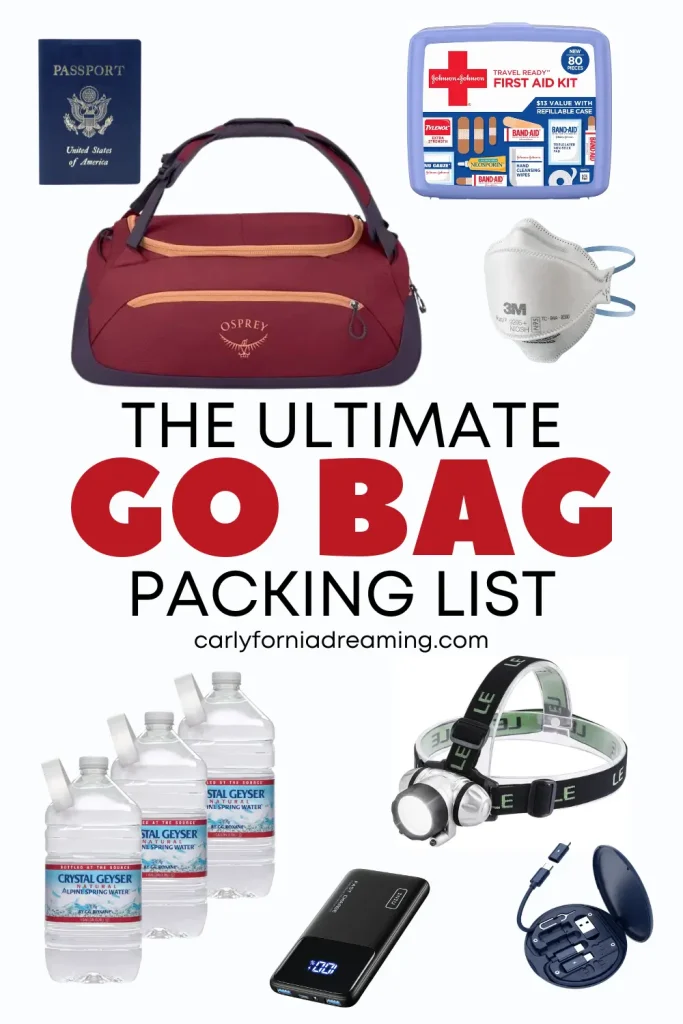
I used my CALPAK Luka Duffel, which holds 25L, for my clothes and valuables. The Osprey Daylite Duffle 30 would also be a good option since you can carry it like a duffle or a backpack. If you have multiple people in your home, each person should have their own Go Bag.
Clothes & Shoes
You don’t have to buy any of these items new. Go through your closet and find items you don’t wear as much or you won’t miss.
Clothing — You should have at least on change of clothes in your Go Bag. Your clothes should be comfortable and warm, like a sweatshirt and sweatpants. (This is an evacuation, not a fashion show.)
Underwear — Someone posted a picture from their local Target after the Los Angeles fires and the entire underwear section was wiped out. I’m the type of person who packs 12 pairs of underwear for a weekend trip. That math absolutely applies to my go bag. If you’re more sensible than I am, a couple of pairs will do.
Shoes — You’ll want to pack a pair of sturdy, closed toe shoes, like sneakers. An older pair of shoes would work well here.
Socks — As Lieutenant Dan said in Forrest Gump: “Take good care of your feet.” Same idea applies here.
Toiletries & Prescriptions
I won’t list out all the toiletries that should be in your Go Bag. When I packed mine, I grabbed the toiletry bag I use when I travel, which contained 90% of what I needed. And don’t forget to pack any medications or prescriptions you may need!
First Aid & Medical Supplies
First Aid Kit — You can buy a small, packable First Aid kit on Amazon.
Face Masks — The air quality after the LA fires was awful. Libraries and drug stores, like CVS and Walgreens, were providing free N95 masks, but having some on-hand is a good idea. KN95 masks would also work.
Food & Water
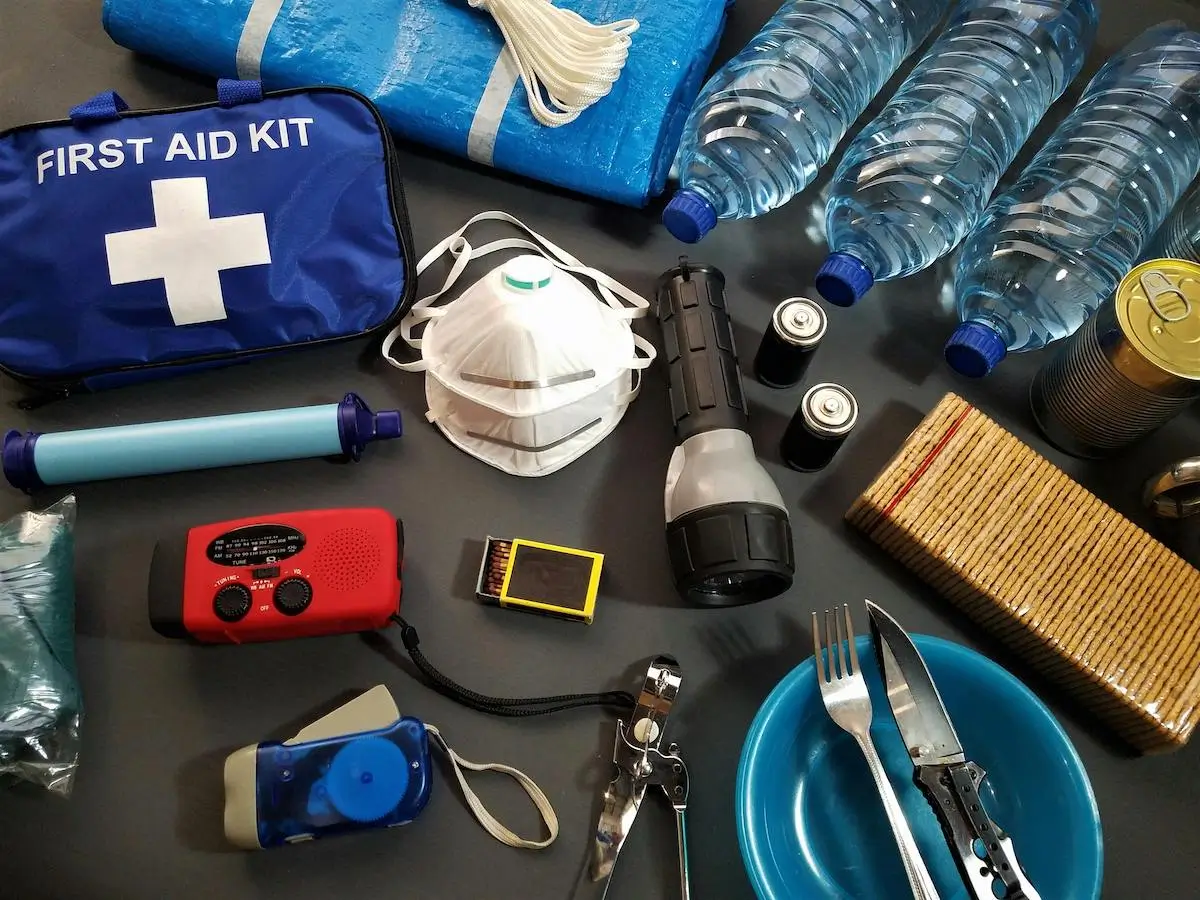
Most sources recommend you have 3 days worth of non-perishable food and 3 gallons of water per person. If you have pets, you’ll need even more water.
For canned goods, make sure you pack a can opener in your go bag so you can actually eat them. And don’t forget to pack eating utensils, too. You’ll also want to set a reminder to check the expiration dates. You don’t want expired food that you can’t eat.
Bottled water should be fine, but the quality can change since the plastic can degrade. Just make sure you store it in n a cool, dry place and not in sunlight.
Important Documents
While I was packing my Go Bag as the Sunset fire burned, I had to sort through stacks of papers to find my mortgage documents, car pink slip and house deed. If I only had a few minutes to get out of my house, this is the last thing I would want to deal with.
Identification Documents — Make paper copies of passports, driver’s license, birth certificate, social security card, etc.
Insurance Policies — Make paper copies of your insurance policies, such as medical, auto and homeowners or rental insurance. Physical copies will come in handy if you have to discuss your policy over the phone.
At the very least, your documents should be stored in something that is waterproof. After some searching on Amazon, I bought this fireproof and waterproof document folder. I put all the important documents I would need to grab in it in the event of an emergency. It also comes with a lock for added protection.
Pet Supplies
Pet Carriers — In general, you should store pet carriers in an easily accessible place. I put both of my cat carriers near the front door in case we had to evacuate.
I saw so many posts on NextDoor about cats escaping from their carriers when people were evacuating. (This is my worst nightmare.) To avoid this, double check that your carrier is secure. If you have a soft-sided carrier (I have this one), make sure there are no holes in it. For added support, hold the carrier underneath.
This is also your reminder to register or update your pet’s microchip information.
Pet Food — Bring enough food (and water) for a couple of days. This will be especially important if your cat eats prescription food. A couple of Churus would also go a long way.
Pet Medication — Pet medication will probably be one of the last things you grab before evacuating. To make it easier, keep all of your pet medications in one place.
Water Bowls — I bought these collapsible water bowls after I realized I didn’t have anything for my cats to drink out of. That would be a problem since one of my cats has hyperthyroidism and drinks a lot of water.
Litter and Litter Box — While packing up my car, I remembered what goes in must come out. Luckily I had a spare litter box and 40 pound bag of cat litter. Once the fires settled down, I ordered smaller bags that I plan to keep with my Go Bag. I’ve also used this kind of litter box, which doesn’t require liners and is super easy to clean.
Tech Gear
Encrypted Drive — You’ll need a USB flash drive or external hard drive for your Digital Go Bag. Encryption will safeguard your data.
Tech Cords and Chargers — If you have an electronic organizer for traveling, consider making a smaller one for your Go Bag with cell phone and laptop chargers. This charging adapter cable kit would also be a good addition to your Go Bag.
Power Bank — Power usually goes out in emergency situations. A Power Bank will help you stay charged in those situations. (I have this Power Bank and it usually holds a fairly decent charge even if you haven’t used it in months.)
Misc Items
Evacuation Routes — If you watched the news, you probably saw how awful traffic was when Palisades residents evacuated. Even the Sunset fire caused a massive gridlock in Hollywood. Experts suggest you have two evacuation routes marked out on a map so you can quickly evacuate the area.
Cash — If the power goes out or networks are down, your credit card or ATM card will be useless. You should have anywhere between $150-$300 per person, although some experts recommend even more. Smaller bills, like $1 and $5 bills, are ideal since it may be hard to get change from larger bills. I also read that you should also have coins, so I also keep a $10 roll of quarters.
Flashlight or Headlamp — These will come in handy if the power goes out.
Batteries (AA and AAA) — Set a reminder to make sure they haven’t expired.
Toilet Paper — It’s never a bag idea to have an extra roll of toilet paper. Sanitary wipes would also work and take up less room. (I use Stall Mates when I travel.)
What to Put in a Digital Go Bag
Being prepared for an emergency goes beyond packing a physical go bag. A digital go bag is necessary for you to access important documents when you can’t return home. Or worse, if they were destroyed due to a natural disaster. Having digital copies on an USB drive or external hard drive will also help speed up the claim process.
Household Identification
These documents will help identify yourself, your children or pets.
Vital Records — Birth certificate, marriage certificate or divorce decree, adoption or custody papers
Identity Records — Drivers license or state ID (front and back), passport, social security card, green card, visa, military service ID
Pet Records — Pet ownership papers, ID tags, microchip informations
Financial and Legal Documentation
These documents will be important if you need to request assistance after a disaster.
Housing Documents — Rental agreements, mortgage documents, deed
Insurance Policies — Homeowners or renters, life, auto, flood, fire
Take a Video Walkthrough of Your Home
If you lose your home or property due to a fire or other natural disaster, it will be hard to create a list of everything you had in your home from memory. Take a full video walkthrough of your home. This includes every room, every closet and drawer, every valuable, every keepsake, every memento. It will become proof for insurance claims. You can also take photos as well.
Vehicle Documents — Loan document, VIN, title, registration
Financial Accounts — Checking, savings, debit cards, credit cards, investment accounts, retirement accounts
Bills — Utility bills, student loans, streaming services, elder care, alimony, child support
Sources of Income — Pay stubs, government benefits, alimony, child support
Estate Planning — Will, trust, power of attorney
Medical Information
Make sure to document each person in your home and important information, like allergies, is at the front and/or easy to find.
Medical Records — List of medications, immunizations, allergies, prescriptions, pharmacy information, medical equipment and devices
Insurance Information — Health, dental, Medicare or Medicaid, VA health benefits
Contact Information — Doctors, dentists, specialist
Contact List
Having a contact list will save you a lot of time if or when you ever need to use it. Your contact list should include: employers, schools, house of worship, social service providers, home repair services, insurance companies, lawyers, government agencies, utility companies and local non-emergency services. Of course, you should also include family and relatives on this list, too.
Go Bag FAQs
Below are some additional questions about packing a physical and digital go bag.
When should I pack a Go Bag?
The best time to pack a Go Bag is before you need one. When I had to pack my Go Bag during the 2025 Los Angeles fires, I wasn’t prepared. When panic sets in (or as my therapist calls it “when your lid is flipped”) you can’t think straight. And if my mom wasn’t with me, I probably would have forgotten a lot of important things. So if you’re reading, now is the perfect time to put together a Go Bag.
Where should I store my documents?
The most popular recommendation is the 3-2-1 backup strategy.
- Three copies of your data: an original “copy” that lives on your computer and two additional copies
- Two different media types: store the two copies of your data on different devices, like the cloud and an encrypted USB drive or encrypted external hard drive
- One copy offsite: keep one copy in a separate, remote location, at least a few miles away from your other two copies, to protect it from theft, fire or other natural disasters
Can I store valuables and important documents in a safe deposit box?
I saw this Instagram post from Nicole Lapin, a money expert who lost her home in the Palisades fire. Bank safe deposit boxes are NOT fireproof. They are fire-resistant and can only withstand temperatures up to 350 degrees for a limited time. Those items are also not FDIC insured.
What about family photos?
Some items, like family photos, are hard, if not impossible to replace after a disaster. Take the time now to digitize all of your photos. They can easily be stored on external hard drives or thumb drives.
Ready to Pack Your Emergency Go Bag?
Save this pin so you’re prepared for an emergency or natural disaster!