LACMA: A Local’s Guide to the Los Angeles County Museum of Art
If you’re planning a trip to Los Angeles and Google “what to do in LA,” the Los Angeles County Museum of Art, or LACMA, is bound to be at the top of the search results.
I live within walking distance of LACMA, so it’s practically in my backyard. I’ve visited a handful of times, but I always left feeling a little underwhelmed. Was it bad? Was I doing it wrong? What was I missing when so many people insist LACMA is one of the best, if not the best, art museums in the city?
When the David Geffen Galleries opened in 2026, I decided to give it one more shot. I wanted to find out whether LACMA was overhyped or simply misunderstood. After spending an afternoon wandering the expansive campus, I finally have an answer.
If you’re wondering whether LACMA belongs on your Los Angeles itinerary, this guide will help you decide.
This post may contain affiliate links, meaning if you decide to make a purchase, I may earn a small commission at no additional cost to you. Read the full privacy policy here.
LACMA at a Glance
📍 Location: Wilshire Blvd & Fairfax Ave (Miracle Mile)
⏰ Time Needed: 2–3 hours
🎟️ Tickets: Check current prices and availability
🚗 Parking: Paid on-site parking or limited metered and free street parking along 6th Street
🚇 LA Metro: D Line (Wilshire/Fairfax Station)
👥 Crowds: Weekends are busiest
🌅 Best Time to Visit: Weekday mornings or late afternoons
🏛️ Pair It With: Academy Museum or the Petersen Automotive Museum
Jump to:
What is LACMA?
The David Geffen Galleries at LACMA
The Rest of the LACMA Campus
What You Can See Without a Ticket
Parking at LACMA
LACMA Tips
LACMA FAQs
What Is LACMA?
Everyone’s in a hurry in Los Angeles. So rather than taking the time to call it the Los Angeles County Museum of Art, everyone simply calls it LACMA. Located on Wilshire Boulevard in the Miracle Mile neighborhood, LACMA is the largest art museum in the western United States.
If you visit LACMA, wear comfortable shoes. The museum’s collection of more than 155,000 objects is spread across three buildings: the Broad Contemporary Art Museum (BCAM), the Lynda and Stewart Resnick Exhibition Pavilion, and the newly opened David Geffen Galleries.
But LACMA extends beyond the walls of its galleries. Some of the museum’s most iconic works, including Urban Light and Levitated Mass, are part of its free, publicly accessible outdoor collection.
The David Geffen Galleries at LACMA
More than 20 years in the making, the David Geffen Galleries opened to the public in May 2026. The building is named after entertainment mogul David Geffen, who donated $150 million toward the $720 million project.
Designed by Swiss architect Peter Zumthor, the 110,000-square-foot structure is made of curved concrete and glass. The single-level structure stretches 30 feet above and across Wilshire Boulevard, connecting both sides of the campus.
In typical Los Angeles fashion, there was plenty of drama when the initial designs were unveiled in the 2010s. Some critics even compared the building to a blob. Now that it’s complete, I think many of those opinions have changed.
What makes the David Geffen Galleries different from a typical boxy art museum, beyond the architecture, is the philosophy behind the space. Museum director Michael Govan wanted to create a museum without hierarchy.
Instead of organizing the collection chronologically or by medium, the galleries are inspired by four major bodies of water and explore how cultures have exchanged ideas, traded goods, and influenced one another across centuries.
It also doesn’t have a defined path through the galleries, which will either excite you or overwhelm you. I found myself somewhere in the middle.
Inside the David Geffen Galleries
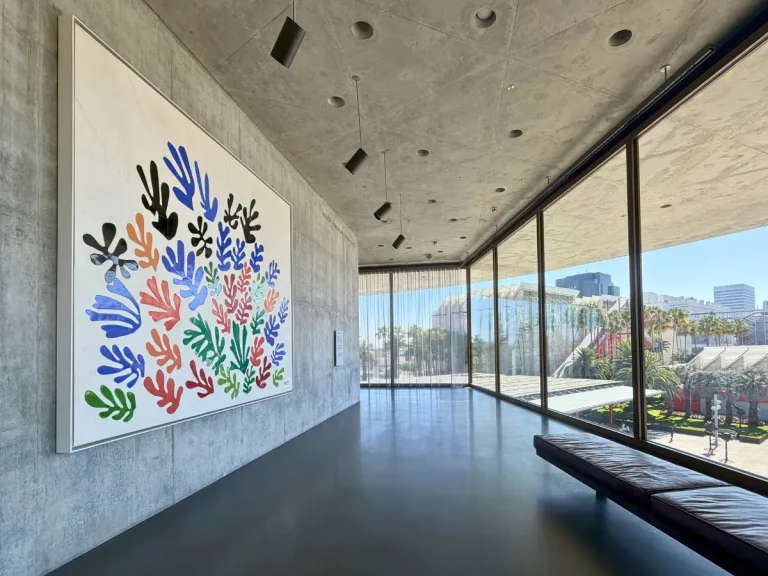
There are two entrances to the David Geffen Galleries: the Elaine Wynn Wing, near the main entrance of LACMA, and the Ressler Family Wing on the opposite side of Wilshire Boulevard. I entered through the Elaine Wynn Wing and was immediately greeted by three large orange horse butts.
The sculpture is called “The Futility of Conquest” by artist Liz Glynn. Writer Mimi Zeigler described it best in The Architect’s Newspaper: “It tells us that history is turned ass-backwards while also suggesting a way to orient yourself in the museum—every direction is all directions and no direction, at once.” It’s been living rent-free in my head ever since and might be one of my favorite things I saw all day.
The overall vibe of the Geffen Galleries is hard to describe. It’s not stuffy or pretentious the way a lot of art museums can feel. It’s more like walking through a very wealthy person’s home where they’ve put their entire art collection on display.
What made me slightly nervous was seeing priceless pieces sitting on tables at a height that any curious child could reach. They’re either delusionally trusting or very brave.
I’m not someone who takes their time in museums; I browse with purpose. I ended up doing two laps. The first was to get the lay of the land. The second was to revisit the pieces that stopped me in my tracks.
Here are my favorites from the David Geffen Galleries:
- Henri Matisse’s “La Gerbe” — positioned in the best spot in the entire gallery, with sweeping views of the LACMA campus
- El Anatsui’s “Fading Scroll” — a large-scale sculpture made from aluminum liquor bottle caps, wrappers, and copper wire that wraps around an entire wall like a metallic patchwork quilt
- Todd Gray’s “Octavia’s Gaze” — a stop-you-in-your-tracks 27-foot-long three-dimensional piece built from multiple framed photographs
- Diego Rivera’s “Flower Day” — once you see it, you’ll instantly recognize it
- Works by Picasso and Magritte are also in the collection
- The views from above Wilshire Boulevard
I spent about an hour browsing before walking over to the other buildings.
The Rest of the LACMA Campus
The David Geffen Galleries may be the new bright and shiny object, but it’s not the only thing to see at LACMA. Located on the other side of the Smidt Welcome Plaza are two more art-filled buildings: BCAM and the Resnick Pavilion.
Broad Contemporary Art Museum (BCAM)
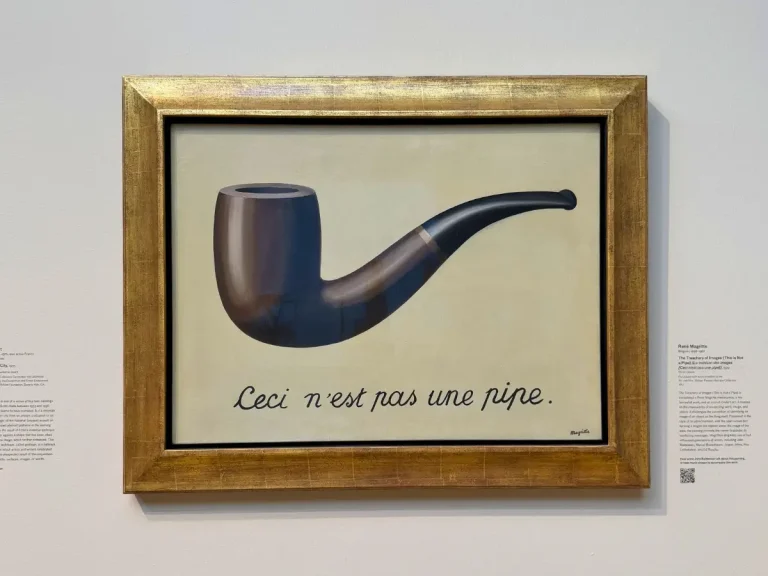
BCAM is a three-level building, and each floor has a distinct personality. The top floor is where you’ll find the heavy hitters: a room dedicated to Picassos, René Magritte’s “The Treachery of Images” (yes, the “This is not a pipe” one), Andy Warhol’s “Campbell’s Soup Can,” and Roy Lichtenstein’s “Cold Shoulder.”
My personal favorite was Meret Oppenheim’s “The Squirrel,” a beer mug with a squirrel tail attached to it. Art, amiright?
If you’ve already been to The Broad in Downtown LA, the top floor will feel familiar. Think of BCAM as the appetizer. If you like what you see here, The Broad is the full meal.
During my visit, the second floor featured Fashioning Chinese Women: Empire to Modernity. Since LACMA regularly rotates special exhibitions, what you see here will likely be different.
The bottom floor is where you’ll find “Metropolis II” by Chris Burden, the same artist behind Urban Light. The large-scale kinetic sculpture features 1,100 custom cars, 8 trains, 5 trolleys, and over 200 buildings. Take the stairs to see it from above. It’s a completely different experience from that angle.
Lynda and Stewart Resnick Exhibition Pavilion
The Resnick Pavilion was my shortest stop of the day, but that doesn’t mean it’s skippable. During my visit, the galleries were split between Impressionist paintings and a section dedicated to block prints.
The standout piece for me was Josiah McElheny’s “Island Universe,” a sculpture that embodies the concept of the multiverse through a series of hanging glass and light installations. In plain terms, it looks like a collection of really beautiful chandeliers.
My inner magpie was very into it, and I spent so much time staring at the different installations that I’m pretty sure the security guards thought I was going to try and steal one.
6 Things You Can See at LACMA Without a Ticket
LACMA has more than 60 outdoor public art works that are free and open to everyone, no ticket required. Here are six you won’t want to miss.
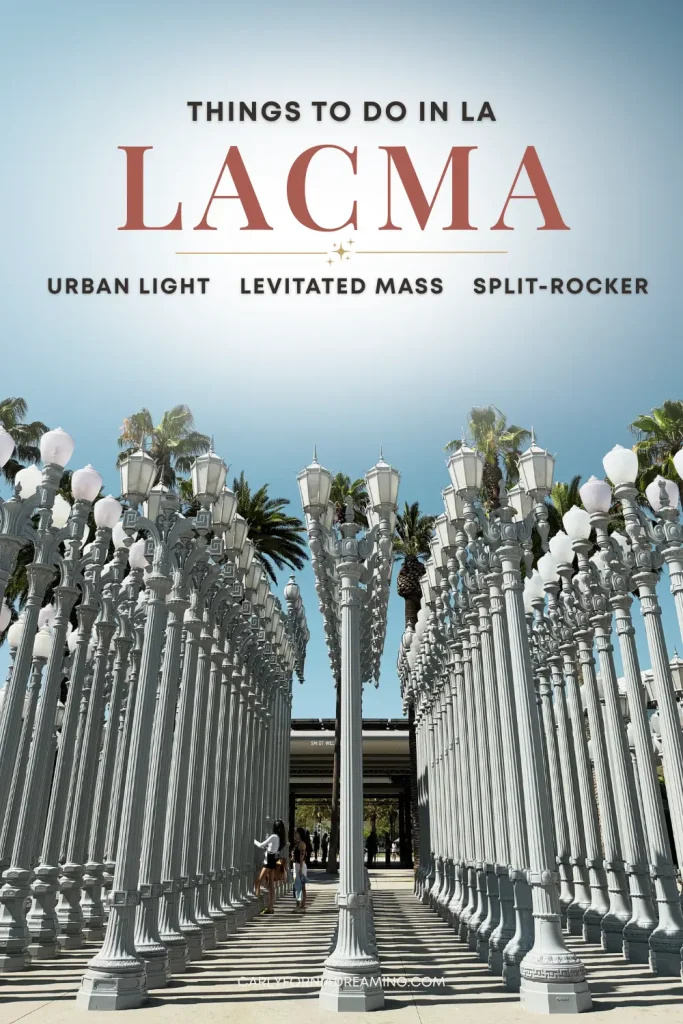
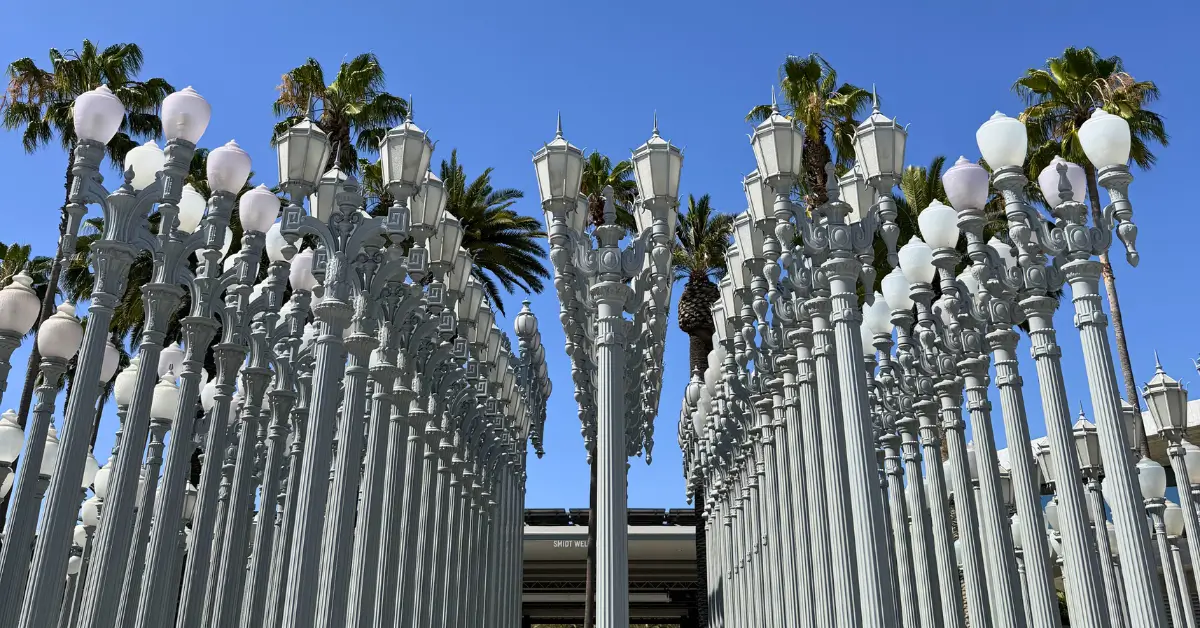
Chris Burden’s Urban Light
Yes, “those street lights in LA that everyone takes photos in front of” has a name. A celebrity in its own right, Urban Light is made up of 202 Southern California street lamps dating from the 1920s and 1930s. Want to know if the lights are on? There’s a website for that.
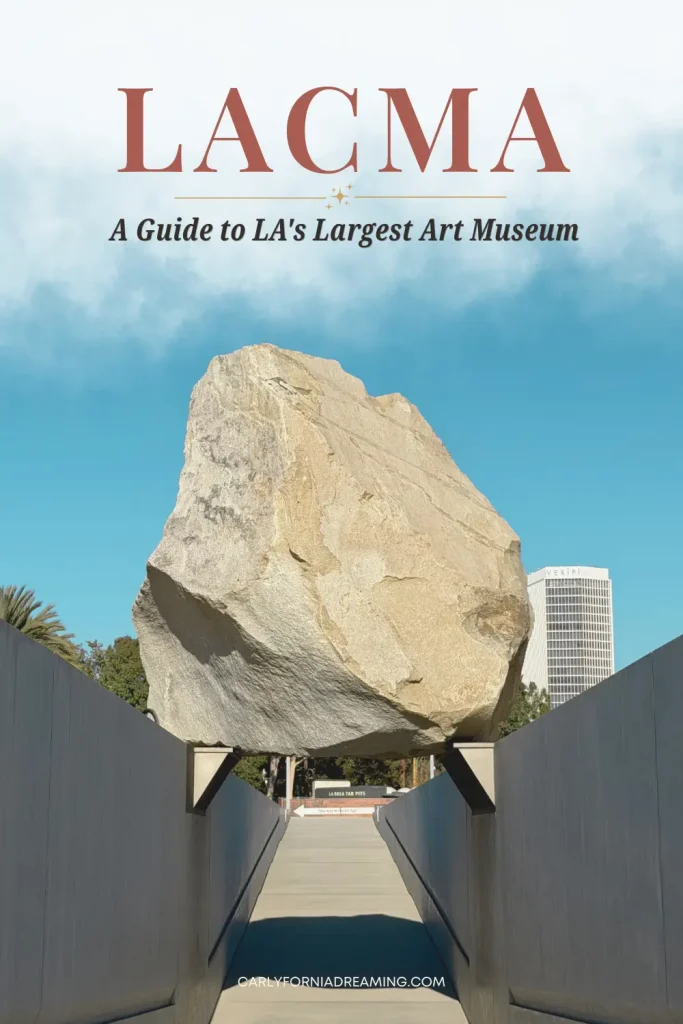
Michael Heizer’s Levitated Mass
The second most Instagrammable installation is the 340-ton granite megalith that precariously sits above a 456-foot-long slot. When it arrived at the LACMA campus in 2012, it took 11 days to travel 105 miles and quite literally stopped traffic. Very on brand for LA.
Jeff Koons’ Split-Rocker
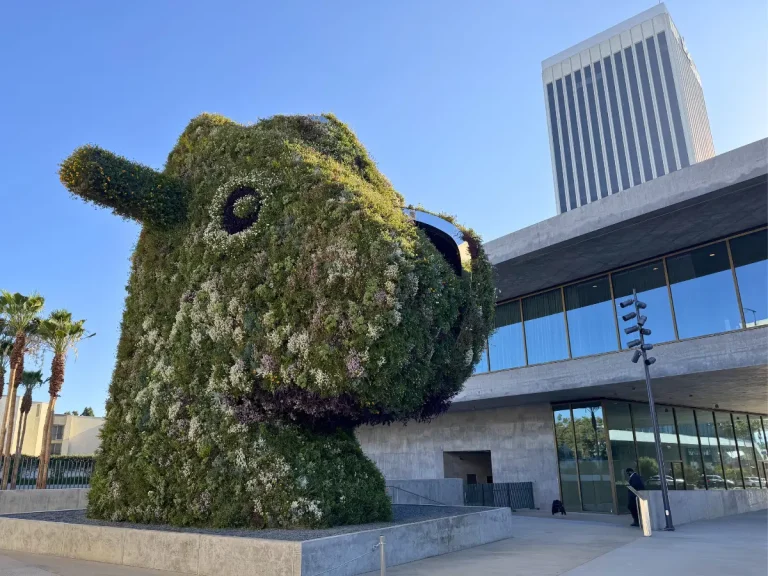
This 37-foot topiary sculpture is the newest addition to the LACMA campus. It’s a combination of a rocking horse and dinosaur. I don’t see it, but maybe you can. The best way to view Split-Rocker is from the east side of the David Geffen Galleries. If you want a close-up, exit from the Ressler Family Wing and turn right.
Ai Weiwei’s Circle of Animals/Zodiac Heads
Angelenos love a zodiac sign, so it’s very fitting that they live on the LACMA campus. The sculptures are recreations of the twelve bronze animal heads that once adorned the Zodiac Fountain at Yuan Ming Yuan, the Old Summer Palace, in Beijing.
B. Gerald Cantor Sculpture Garden
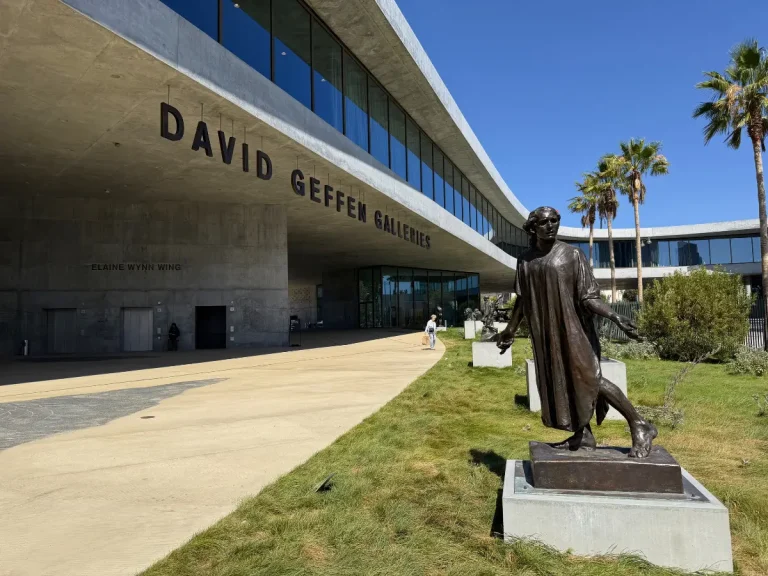
After touring the world during construction, the 50 Rodin sculptures are back in LA. I was particularly drawn to “Jean de Fiennes, Draped” because it looks how I feel every day.
Alexander Calder’s “Three Quintains (Hello Girls)”
The fountain has been reinstalled near the Erewhon at LACMA. Because of course there’s one here.
See the Best of LA for Free
LACMA is just one of the many places that prove you don’t need a lot of money to visit LA. Check out my guide to the best free things to do in Los Angeles.
Los Angeles County Museum of Art Parking
Parking at LACMA is kind of like a Jackson Pollock painting: messy and chaotic.
Parking in the Pritzker Parking Garage on 6th Street costs $23, which is almost as much as a ticket to LACMA itself. Luckily, there are a couple of alternatives.
Metered parking is available on the south side of 6th Street between the Pritzker Parking Garage and Curson Avenue. Free parking exists on the north side of 6th Street, and you can also find free parking just past the light at Curson.
The catch is that finding street parking on a weekend, or even a weekday, is like competing in the Hunger Games. If you do manage to find these elusive and affordable parking spots, make sure you read the signs so you don’t get a ticket.
If you’d rather skip the parking situation entirely, a rideshare or the Metro are great ways to keep your stress levels and expenses low. The newly opened Wilshire/Fairfax station on the D Line is right across the street from LACMA.
Tips for Making the Most of Your LACMA Visit
A museum this size requires a game plan. Here are a few things that will make your visit run a lot smoother.
LACMA is closed on Wednesdays, so keep that in mind when planning your visit.
If you want to avoid crowds, go in the morning or late afternoon. Fridays in the summer are particularly busy because LACMA hosts free outdoor jazz concerts, which are great if you’re into that sort of thing, but not ideal if you’re there to see the art.
Reserve your ticket ahead of time. When I arrived, there was a fairly long line at the Welcome Kiosks for people who hadn’t booked ahead. You can reserve same-day through the LACMA website, and all you need is a QR code on your phone to access the galleries.
LACMA FAQs
Still have questions? Here are answers to some of the most common questions about visiting LACMA.
Where is LACMA located?
LACMA is located at 5905 Wilshire Boulevard in the Miracle Mile neighborhood of Los Angeles, between the Academy Museum and the La Brea Tar Pits.
Is LACMA free?
LACMA isn’t free to visit, but there are a few ways to get in without paying admission. LA County residents get free admission Monday, Tuesday, Thursday, and Friday from 3 p.m. to closing. LACMA also has a free admission day on the second Tuesday of every month. Even if you don’t go inside, the outdoor public art collection, including Urban Light and Levitated Mass, is always free to visit.
What are the must-see attractions at LACMA?
The David Geffen Galleries are the centerpiece of LACMA and should be at the top of your list. Other must-see attractions include Urban Light and Levitated Mass.
Where is Urban Light located?
Urban Light is located in front of LACMA along Wilshire Boulevard near the Smidt Welcome Plaza. It’s free to visit and doesn’t require museum admission.
What other museums are near LACMA?
The Petersen Automotive Museum and the Academy Museum of Motion Pictures are both within walking distance on Wilshire Boulevard, making them easy to combine with a visit to LACMA. The La Brea Tar Pits are also next door, but the museum is closed for renovations until 2028.
Should You Visit LACMA?
Many people, Angelenos especially, argue that LACMA isn’t the best art museum in Los Angeles and that you’re better off going to the Getty or The Broad. And I think that answer, like art, is subjective.
With the opening of the David Geffen Galleries, I think LACMA is absolutely worth a visit. As someone who recently decided they’re not an art museum person, I was surprised by how much I enjoyed the new LACMA. But maybe the three horse butts were doing the heavy lifting.
Pin Now, Plan Later
Save this LACMA pin for your LA itinerary!